
Email isn't just where work happens — it's where attackers go first. ECSG layers six independent defenses across your mailbox, endpoints, and network perimeter, so one bad click is never enough to breach your business.
Ransomware, credential theft, and wire fraud almost always start the same way — with a single email that looks like it belongs in your inbox.
of successful cyberattacks begin with a phishing email
CISAin FBI-reported Business Email Compromise losses in 2024 alone
FBI IC3average cost of a single Business Email Compromise attack
IBM Cost of a Data Breach, 2025of data breaches involve a human element — phishing, stolen credentials, or social engineering
Verizon DBIRBefore any advanced tool gets involved, we make sure the basics are configured correctly — because most email spoofing succeeds when these are missing, weak, or misconfigured.
.svg)
The inbox itself — the front door attackers target most.
Direct where your mail is delivered — the entry point we lock down first.
Declares exactly which servers are allowed to send email for your domain.
Digitally signs outgoing mail so recipients can verify it wasn't altered.
Tells receiving servers what to do with mail that fails SPF/DKIM — and reports back to us.
Automatically and securely configures Outlook with the correct server settings.
SPF, DKIM, and DMARC stop obvious spoofing — but they don't stop a convincing, targeted attack from a lookalike domain. That's where Proofpoint takes over.

Detects and blocks spear-phishing and impersonation attacks built specifically to fool your employees — not just generic spam.
Every link is rewritten and checked in real time at the moment it's clicked, not just when it was delivered.
Flags emails that mimic your executives or vendors before a wire transfer or credential request ever reaches an inbox.
Malicious attachments are detonated and analyzed in an isolated environment before they ever reach a user.
Backed by threat data from billions of messages processed daily across Proofpoint's global customer base.
If a threat is caught, delivery is stopped — without disrupting the legitimate email your team relies on.
Even if a threat gets past email, it still has to survive the endpoint. Most people have never heard of SentinelOne — and that's exactly why it's so effective.

An autonomous AI agent runs directly on every endpoint, spotting malicious behavior in real time — with or without an internet connection.
If ransomware slips through, SentinelOne can roll a device back to its pre-attack state in seconds — no full reimage required.
Threats are isolated and neutralized automatically, without waiting on a human analyst to act first.
Detects fileless malware and zero-day attacks by watching what a process does, not just matching known signatures.
Every incident is reconstructed into a visual timeline, so we know exactly how an attack started and what it touched.
The same protection extends across Windows, macOS, and Linux devices in your environment.
Most attacks that survive email still need your browser to finish the job — a malicious link, a fake login page, a drive-by download. DefensX shuts that path down at the browser and DNS layer.
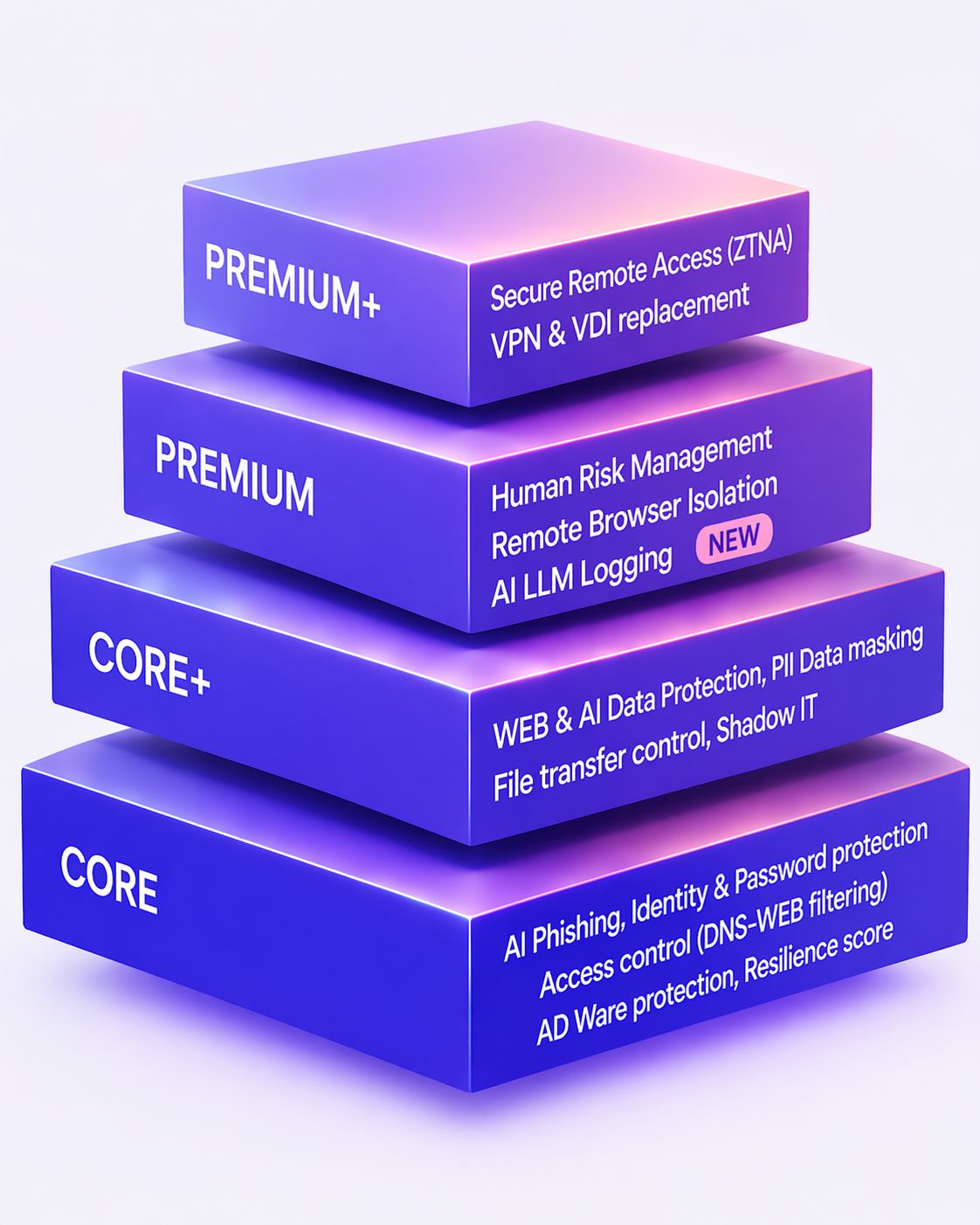
Layered protection tiers — DefensX scales from core DNS filtering up to full browser isolation and Zero Trust access, so protection grows with your risk profile.

Policy-aligned browser protection — content and file filtering, plus session and credential guarding, applied automatically per user and group policy.

Human risk dashboard — real-time, automated visibility into risky behavior and vulnerabilities across your organization.
Policies are applied by group — department, role, or risk level — instead of configuring every user one by one.
We build allow/block lists specific to your business — vendors, tools, and sites your team actually needs.
Malicious domains, phishing infrastructure, adult content, gambling, and dozens of other risk categories, filtered by policy.
Detects when a corporate password is typed into a non-corporate site — stopping credential reuse and phishing pages in the moment.
Risky or unknown sites are rendered in an isolated cloud container — nothing malicious ever touches the actual device.
Secure access to internal apps without a legacy VPN — extending protection to remote and hybrid teams.
Everything above this point protects a mailbox, a browser, or a device. The firewall protects the network itself — the boundary between your business and the open internet. It sits here deliberately: after the user-facing layers, because it isn't guarding a person's inbox or browser — it's guarding every device, server, printer, and camera on the network at once, including the ones that can't run an agent.

Scans traffic at the gateway and blocks known malware, worms, and Trojans before they ever reach a device on the network.
Blocks the installation of spyware at the network level and disrupts covert communications from spyware already present.
Deep packet inspection scans every connection in real time for exploits, buffer overflows, and known attack signatures — and blocks them automatically.
Granular policies decide which applications are allowed to run on the network at all, and how much bandwidth they're permitted to use.
Real-time, real-world visibility into exactly which applications are running across the network — not just what's technically allowed.
Category-based web filtering enforced network-wide, blocking malicious, inappropriate, and non-business categories of sites for every device behind the firewall.
Every event the firewall sees — blocked connections, intrusion attempts, outbound anomalies — is streamed as a continuous log feed into RocketCyber / Kaseya MDR. The firewall doesn't just defend the perimeter on its own; it becomes another set of eyes for the SOC below, correlated in real time against what's happening on your endpoints and in Microsoft 365.
🌐 Configured, licensed, and maintained remotely — no site visit neededEvery layer above generates signals. This is where those signals meet a real Security Operations Center — human analysts watching, validating, and acting, 24 hours a day.

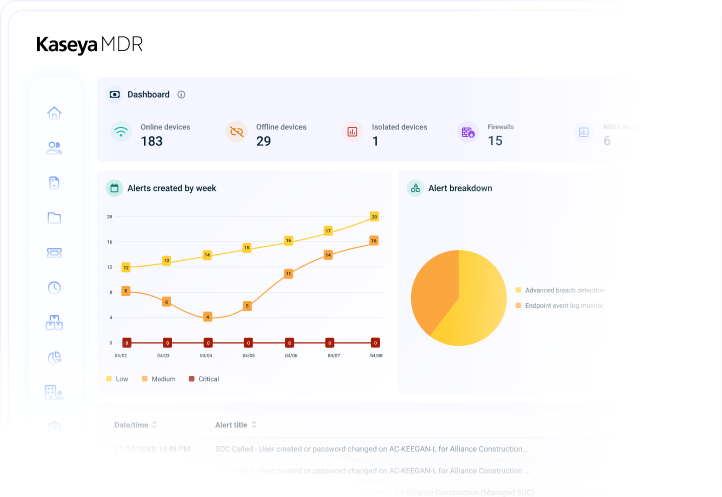
The MDR console — formerly RocketCyber, now Kaseya MDR: an alert-centric SOC view monitoring endpoints, Microsoft 365, and firewalls simultaneously.

Proactive threat hunting — analysts apply an extensive threat-indicator database to catch what automated tools alone would miss.
Real security analysts — not just automation — review and validate every alert, every hour of every day.
AI correlation cuts through noise and false positives, so analysts spend their time on real threats, not alert fatigue.
RocketCyber / Kaseya MDR ingests the log feed directly from your firewall, correlating network-edge events with endpoint and email activity in one view.
The three attack surfaces that matter most for an SMB, monitored together instead of in separate blind spots.
Suspicious processes are killed and endpoints isolated automatically the moment ransomware behavior is detected.
When something needs attention, ECSG gets a precise, actionable ticket — not just a raw alert to decipher.
Long-term visibility for investigations, audits, and compliance — well beyond what most tools retain.
Tools alone don't stop breaches — attention does. RocketCyber / Kaseya MDR is the layer where every signal from Outlook, Proofpoint, SentinelOne, DefensX, and your firewall converges into one place, watched by people whose only job is to catch what automation missed.
🌐 A 24/7 SOC watching remotely, so distance never delays a responseYou don't need a server room or a technician standing by. Our entire stack deploys remotely — a single agent install brings your environment under ECSG's management from day one, no matter where your team is located.
Book a discovery call and we'll show you exactly where your current email security has gaps — no cost, no obligation.